

Reed adjustment & notes
Many factors influence a reed's overall playability, and my student and intermediate/advanced reeds allow for plenty of room for adjustment to accommodate different players, bocals, and instruments. I also added a small diagram of the most influential areas I have found when adjusting and finishing my reeds.
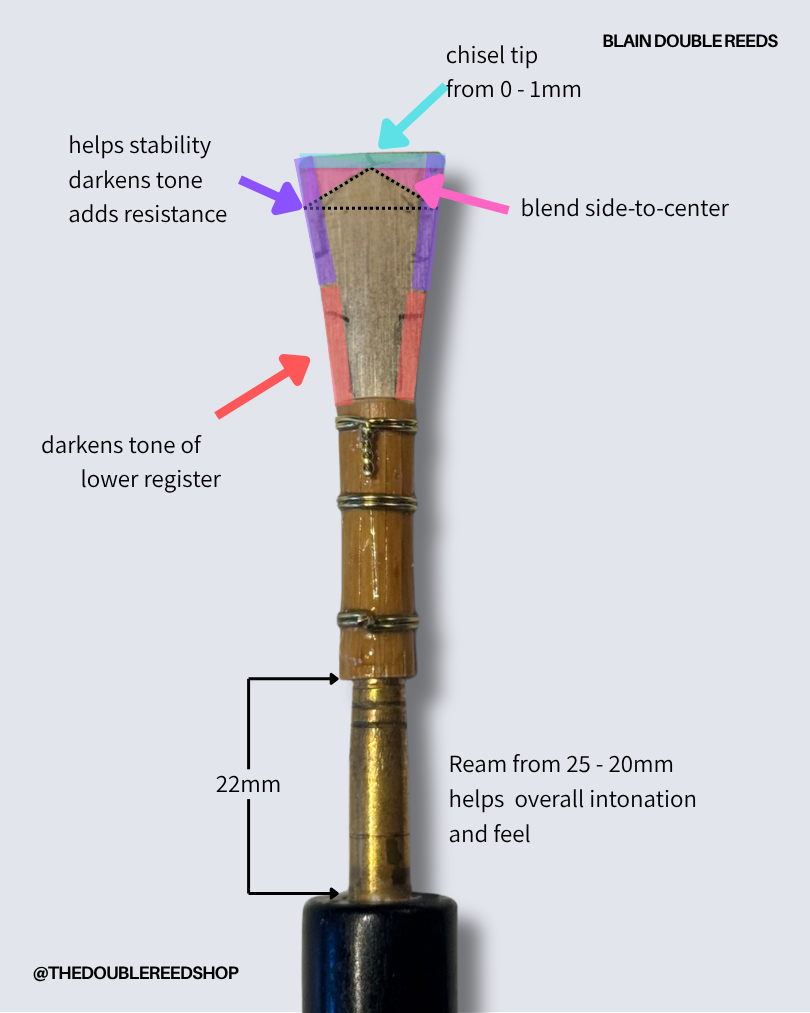
Here are a few quick notes regarding reed adjustment:
Play-tested: All reeds I make are play-tested using a Heckel CC2 and Fox C2 bocal on a modern thick-wall long-bore professional bassoon and tuned to A=440hz
Wire adjustment: The wires and wrapping are glued using a flexible water-resistant acrylic medium, allowing the wires to be tightened if needed. I recommend using a forming mandrel when tightening wires to avoid collapsing the reed tube.
Reed Adjustment: Adjust the reed with extreme care as the profile is an 'almost parallel' tip-taper scrape style reed without a well-defined spine. Broad adjustments are not required to refine a handmade reed's playability. There are only very few areas to adjust, either filing, using a knife, or using sandpaper
Reaming the tube: When a customer receives reeds, the tube should sit around 24-25 mm from the handle of a Fox forming mandrel, and can be reamed up to 20mm for bocal fitment and playing stability. I recommend using a Rieger spiral reamer for this process
Shortening the blade: The reed blade can be cut back 0-3 mm (resulting in a total blade length of 25-28 mm) without negatively affecting the overall profile adjustment. My best-playing personal reeds have blade lengths of 26-27.5 mm
Refining the tip: When refining the tip of the reed, be very cautious in the middle of the blade. I have found the best practice is to define a chisel-like tip (0–1 mm) on the reed blade and work from the sides toward the center when blending.
Blending the scrape: To accommodate moderate flatness and brightness, adjust the extreme wings, blending them into the rails of the reed, which is the same adjustment used for a parallel scrape reed.
Bright Low Register: To remove 'reediness' in the low register, adjust the far rails in the back third of the reed, avoiding the middle of the reed.